1 Why dimensional psychiatry is essential today
Contemporary understanding of mental health goes far beyond traditional diagnostic categories.
Saying that a person has an "anxiety disorder," "depression," "post-traumatic stress disorder," or "ADHD" describes symptomatic manifestations, but not the invisible mechanisms that generate and maintain suffering.
Dimensional psychology focuses on transdiagnostic psychopathological processes, that is:
- • Dysfunctional psychological mechanisms common to many disorders,
- • that organize inner experience,
- • and that constitute the invisible mental foundation behind observable manifestations.
It allows us to think of suffering on a normal–pathological continuum, rather than fixing it in categories.
2 At the heart of these processes: identity (the "I"), or self-representation
All psychological processes—thoughts, emotions, behaviors, relationships with others—emerge from a fundamental dimensional mechanism: self-representation, that is, the issuer of all daily experiences.
This mechanism exists on a continuum:
An already satisfied self
Serene, valid
An unsatisfied self
Insecure or invalid
When the "I" experiences itself as deficient, attempts to resolve this alteration become compensatory strategies—what we call ontological addiction (Barrows et al., 2022; Ducasse et al., 2025; Gordon et al., 2018).
3 The central principle
"It is from ourselves, as we usually identify ourselves, that we have all our daily experiences. So if the representation we have of ourselves is altered, all our daily experiences will be altered."
— Ducasse et al., 2019
4 Three forms of self-alteration, three organizations of suffering
This root process is organized into three dimensional poles, each associated with adaptation strategies and specific disorders.

1) The "self in insecurity" → experiential avoidance
Claire
When the "I" experiences itself as threatened: hypervigilance, need for control, fear of the unexpected, intolerance to any form of discomfort.
Dominant strategy: control, flee, neutralize or anesthetize inner experience.
Psychological mechanism involved in: anxiety disorders, PTSD/cPTSD, addictions (cannabis, opioids, benzodiazepines), and the helplessness that follows the struggle: depression, burnout.

2) The "unsatisfied self" / affective emptiness → craving for stimulation
Karim
When the "I" experiences itself as empty, without internal satisfaction: chronic boredom, distractibility, agitation, need for intensity.
Dominant strategy: seek external stimulation.
Psychological mechanism involved in: addictions to gambling, sex, shopping, risky driving, sensation seeking, vulnerability to triggering hypomanic episodes, ADHD.

3) The "self lacking worth" → disconnection and excessive self-reflexive awareness
Julie
When the "I" experiences itself as "not enough," "unworthy," "unlovable": shame, self-criticism, perfectionism, fear of rejection.
Dominant strategy: hide, over-adapt, appear, prove, or dissolve into the other.
Psychological mechanism involved in: anorexia, emotional dependence, borderline disorder.
4) Borderline disorder: a name for the 3 facets of the "lacking self" pushed to the extreme
Borderline disorder can be read as a magnifying mirror of our ordinary human functioning, where the three alterations of the self (insecurity, dissatisfaction, lack of worth) are simultaneously exacerbated.
5 The major therapeutic risk
"If the 'I' remains insecure, dissatisfied or unworthy of being loved, all psychotherapeutic strategies put in place to reduce suffering will also be altered. It would be like treating the wrong patient."
— Ducasse et al., 2019
6 Where does LiACT stand? At the heart of 3rd wave CBT, in a process approach
LiACT integrates 3rd wave CBT in a dimensional perspective, which transcends the categorical approach.
These therapies have a common goal: to oppose the processes that emerge from an altered self-representation.
The root dimension to transform is always the same: the "I" (or self-representation) that experiences.
7 The three process levels trained by LiACT
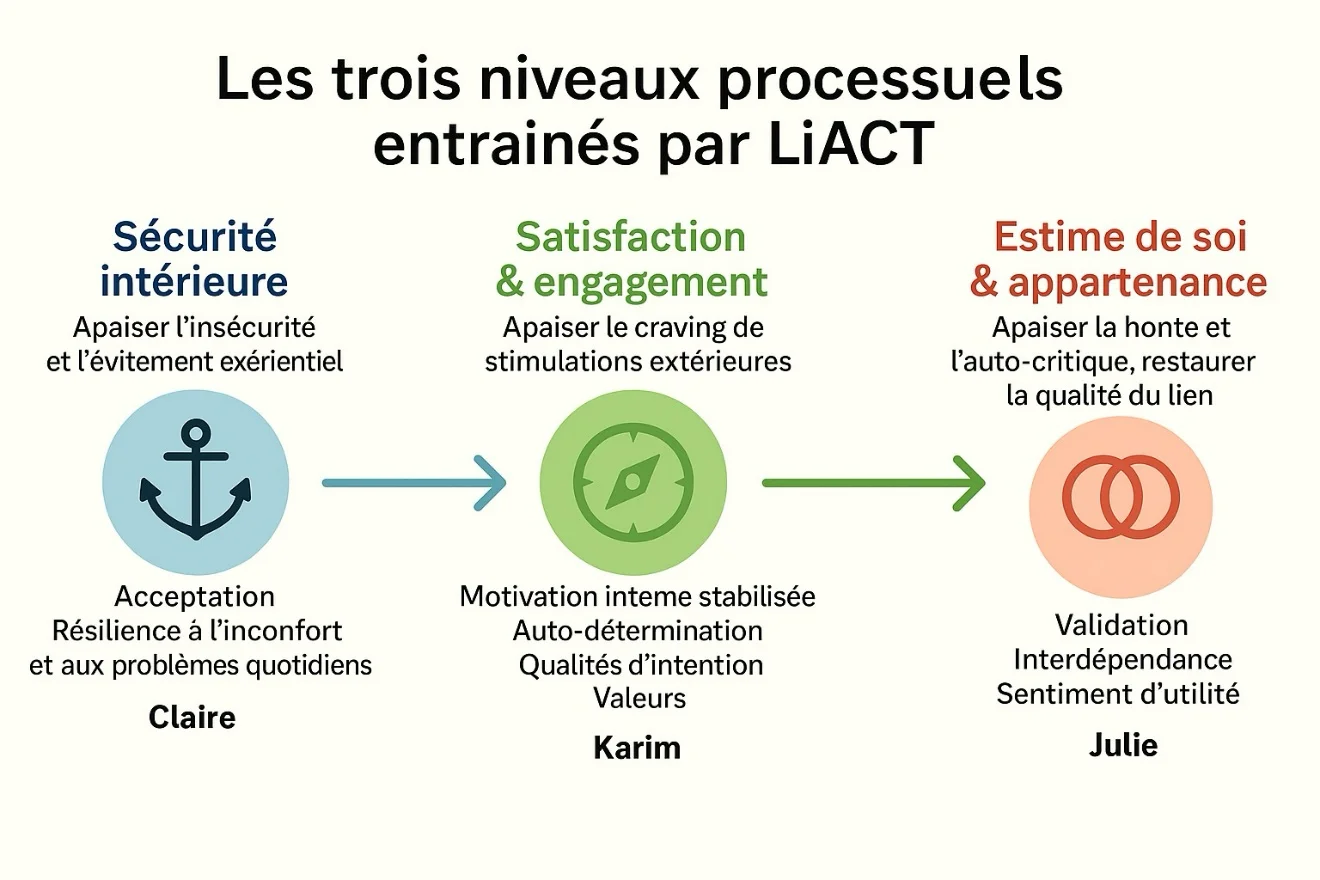
Level 1 — Inner Security (Claire)
Objective: Soothe insecurity and stop experiential avoidance
Key processes: Acceptance – Resilience to discomfort and daily problems
By responding to experiential avoidance with acceptance (worked on in various protocols, such as the Barlow method and TIPI), and adding a valid identity conclusion, → this establishes inner-sourced security.
Integrated approaches: Barlow method, TIPI, DBT, ACT
Level 2 — Satisfaction & Engagement (Karim)
Objective: Soothe craving for external stimulation
Key processes: Stabilized internal motivation – Self-determination – Intentional qualities – Values
By responding to craving with: inner-sourced motivation, the ability to generate continuous and stable interest, in a playful mindset, with an intention to contribute, with an intention to grow and progress, then adding a valid identity conclusion, → this establishes inner-sourced well-being.
Integrated approaches: Self-compassion (Kristin Neff), loving-kindness practices, ACT motivational processes
Level 3 — Self-esteem and Belonging (Julie)
Objective: Soothe shame and self-criticism, restore relational quality
Key processes: Validation – Interdependence and sense of usefulness
By responding to disconnection with: a sense of belonging and worth through a sense of usefulness (in being and doing), existence in interdependent relationships, reduction of self-criticism and excessive preoccupation with one's own worth and place, then adding a valid identity conclusion, → this establishes an inner-sourced sense of worth.
Integrated approaches: Adlerian psychology, advanced levels in 3rd wave CBT
LiACT stands at the crossroads of these three levels
8 What LiACT is, precisely
LiACT is a self-support AI focused on:
- • transnosographic processes,
- • self-representation as the root lever,
- • the three dimensional levels of 3rd wave CBT,
- • structured training in daily life.
LiACT is not a substitute for psychotherapy or medical follow-up, and does not aim at diagnosis or treatment of a disorder.
It offers a guided framework for working on how the "I" experiences itself, others and the world.
LiACT is not yet another therapeutic protocol: it draws on 3rd wave CBT to extract and train the most relevant psychological processes, in a digital self-support format.